
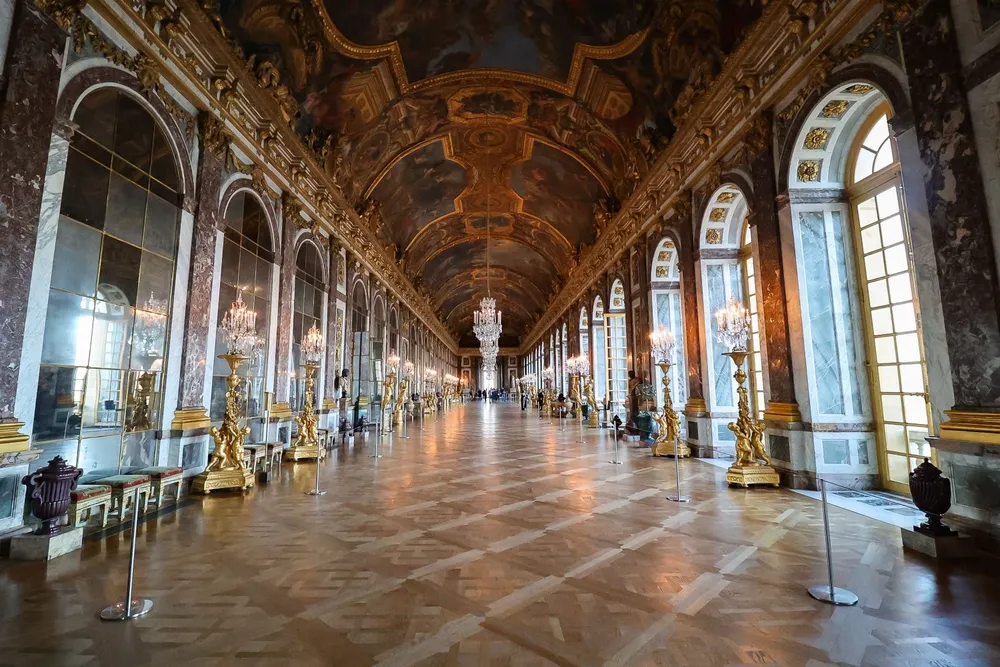
Seven million people visit the Palace of Versailles every year. Each one of them walks on original parquet floors, breathes the same air as the gilded plasterwork of the Grand Apartments, and moves through spaces that have survived revolution, war, occupation, and three and a half centuries of continuous use. The fact that the palace exists at all in the condition it does is, on reflection, a minor miracle. The fact that it continues to survive — and in some respects to improve — is the result of one of the most complex, expensive, and quietly remarkable conservation programmes in Europe.
Most visitors walking through the Hall of Mirrors or crossing the parterre don’t think about what it takes to keep that experience intact. They shouldn’t have to — that’s the point. Successful conservation is invisible. You experience its results without registering the effort behind them. But the story of how Versailles is being saved is genuinely fascinating, and understanding it changes how you look at the palace during your visit.
This is that story.
The Scale of the Problem — Why Versailles Is So Difficult to Preserve
To understand the conservation challenge at Versailles, you need to start with the numbers. Not the visitor numbers — though those matter enormously — but the physical numbers of the palace itself.
What the Palace of Versailles Actually Is
The Palace of Versailles is not a single building. It is a complex of structures covering approximately 67,000 square metres of floor space across the main palace alone, with an additional 800 hectares of gardens, two satellite palaces — the Grand Trianon and the Petit Trianon — and the Marie Antoinette Estate adding further managed heritage space to the total.
The main palace contains 2,300 rooms. Its facades stretch for approximately 680 metres along the garden front. The roof covers an area large enough to accommodate multiple football pitches. The Hall of Mirrors alone contains 357 mirrors, 20,000 individual mirror pieces, 150 chandeliers and candelabras, and a painted ceiling programme comprising 30 separate compositions. Every one of these elements requires specialist maintenance on a rotating schedule.
The gardens contain 200,000 trees, 50 fountains with 620 individual water jets, 27 kilometres of trelliswork, and a Grand Canal hydraulic system that dates in its original form to the seventeenth century. Maintaining the hydraulic infrastructure alone — the underground pipes, pump systems, and water management equipment that keep the fountains operational — is an engineering programme that never fully stops.
The Enemies of Versailles — What’s Actually Causing Damage
The threats to the Palace of Versailles fall into several distinct categories, each requiring a different conservation response. Weather is the most persistent and in some ways the most damaging. The French climate — cold and wet in winter, hot and dry in summer — creates cyclical stress on the palace stonework, roof structures, and garden features that compounds over decades. Freeze-thaw cycles cause stone to fracture. Summer heat accelerates the degradation of gilded surfaces. Rain infiltration, where roof or drainage systems have deteriorated, causes interior damage that can be catastrophic if not caught early.
Tourism impact is the second major threat — and the one most directly connected to the visitor experience. Seven million pairs of feet per year on original parquet flooring creates cumulative mechanical stress that no maintenance programme can fully eliminate, only manage. The vibration of large visitor numbers in the Hall of Mirrors affects the chandeliers and ceiling plasterwork. The humidity generated by thousands of visitors breathing in enclosed spaces accelerates the deterioration of painted surfaces and gilded ornament.
Air pollution — both external urban pollution and the internal pollution generated by visitor traffic — causes discolouration and chemical degradation of painted ceilings, marble surfaces, and gilded decorative elements at a rate that is slow enough to be invisible in any single visit but significant over years and decades.
The Paradox of Tourism — The Threat That Also Funds the Solution
The most uncomfortable fact in Versailles conservation is that the primary threat to the palace and the primary source of funding for its preservation are the same thing: visitors. Ticket revenue from seven million annual visitors provides the financial foundation for the palace’s operational budget, which includes a significant conservation component. Without the visitors, the funding base for preservation collapses. With too many visitors, the physical fabric of the palace degrades faster than conservation can address.
Managing this paradox is the central challenge of Versailles conservation policy — and it is one that the palace management has addressed with increasing sophistication over the past two decades through timed entry management, visitor flow control, and the strategic use of digital access to reduce pressure on the most fragile physical spaces.
The Restoration Programme — What Has Been Done and What Is Ongoing
The formal restoration programme at Versailles has been running in various forms since the palace was converted into a national museum in 1837. Its modern phase — systematic, technically sophisticated, and internationally collaborative — began in earnest in the late twentieth century and continues today under a multi-decade masterplan.
The Hall of Mirrors Restoration — The Flagship Project
The most visible completed restoration project at Versailles is the Hall of Mirrors, which underwent a comprehensive restoration between 2004 and 2007 at a cost of approximately €12 million. The project involved the cleaning and consolidation of the ceiling paintings by Charles Le Brun, the restoration of the gilded stucco and bronze ornament throughout the gallery, the replacement of deteriorated mirror panels, and the restoration of the original window hardware and floor parquet.
The ceiling restoration alone required a team of specialist conservators working from suspended scaffolding platforms for three years, cleaning centuries of accumulated grime, consolidating flaking paint layers, and in places carrying out careful inpainting of losses using historically accurate pigments and techniques. The chandeliers — all 150 of them — were removed, disassembled, cleaned, and reassembled individually.
The result is the Hall of Mirrors that visitors see today: not the room as it appeared in 1700, but a reasonable approximation of its appearance in the late nineteenth century, before the accumulated effects of the twentieth century’s pollution and neglect had taken their toll. The restoration also installed a modern climate control and humidity management system behind the scenes — invisible to visitors but fundamental to slowing the rate of future deterioration.
The Garden Restoration — Replanting the Grand Design
The gardens of Versailles present a conservation challenge of a different kind: they are living, growing, and constantly changing in a way that the palace interiors are not. The trees that André Le Nôtre planted in the seventeenth century do not live forever, and the geometric patterns of the allées and bosquets depend on the trees and hedging maintaining their designed forms.
A major replanting programme — the Grand Trianon replanting of 1999 and the broader estate replanting following storm damage in December 1999, when 10,000 trees were lost in a single night — accelerated what was already a rolling replanting schedule. The storms of 1999 destroyed approximately a third of the estate’s trees in one event, prompting an emergency replanting programme that introduced tens of thousands of new trees across the estate in the years that followed.
The replanting is not simply a matter of putting new trees in the ground. The species selection, the spacing, the training of young trees into the geometric forms that Le Nôtre intended — all of this requires horticultural expertise that balances historical fidelity with the practical realities of twenty-first century growing conditions, including climate patterns that differ from those of the seventeenth century in ways that affect which species thrive in specific locations.
The Royal Chapel and the Petit Trianon — Current Active Projects
The restoration work currently active at Versailles — as of 2026 — includes major projects on the Royal Chapel and elements of the Petit Trianon estate. The Royal Chapel, completed in 1710 and considered one of the finest examples of French Baroque religious architecture, has been undergoing a phased restoration of its painted vaults and stone structure that began in the mid-2010s and continues in sections.
The Petit Trianon restoration — focused on the interior decorative programme commissioned by Marie Antoinette — involves the meticulous reconstruction of textile furnishings based on surviving documentary evidence, the restoration of painted boiserie panels, and the return of period furniture from French national collections to rooms from which it was dispersed during the Revolution. The goal is not a reproduction of the original but a scholarly reconstruction that conveys the atmosphere and character of the queen’s private space with the highest possible historical accuracy.
The Technology Behind the Preservation
Modern Versailles conservation is not simply a matter of skilled craftspeople applying historical techniques — though those craftspeople and those techniques remain central. It is also a sophisticated technical programme that uses twenty-first century tools to understand, monitor, and protect a seventeenth century building at a level of precision that was not previously possible.
3D Scanning and Digital Documentation
Every major space in the Palace of Versailles has been subject to high-resolution 3D laser scanning as part of the palace’s digital documentation programme. The resulting point cloud data creates millimetre-accurate three-dimensional records of architectural surfaces, decorative elements, and structural forms that serve two purposes simultaneously.
The first is conservation monitoring: by comparing scans taken at intervals of several years, conservators can identify changes in surface geometry — cracks propagating, stonework shifting, plasterwork separating from its substrate — before those changes become visible to the naked eye or progress to the point of causing irreversible damage. This predictive approach to maintenance represents a significant advance over the reactive approach that characterised conservation practice for most of the palace’s history.
The second purpose is documentation for restoration: if a decorative element is damaged or lost, the scan data provides the geometric basis for reconstruction at a level of accuracy that hand measurement alone cannot achieve. The digital record is also a form of insurance — if catastrophic damage were ever to occur, the scan archive provides the information base for an informed reconstruction response.
Climate Monitoring and Environmental Control
The Palace of Versailles has an extensive network of environmental monitoring sensors distributed through the main palace, the Trianon buildings, and the storage facilities that house objects not on permanent display. These sensors monitor temperature, relative humidity, light levels, and particulate pollution in real time, feeding data to a central conservation management system that allows staff to identify and respond to environmental threats before they cause material damage.
The humidity management system installed during the Hall of Mirrors restoration is the most sophisticated element of this network. Maintaining stable relative humidity in a room that receives thousands of visitors per day — each of whom is a source of moisture through respiration — requires continuous monitoring and active intervention through concealed ventilation systems that adjust in response to occupancy levels. The system is invisible to visitors and inaudible under normal conditions. It is also fundamental to the long-term survival of the ceiling paintings and gilded ornament.
Augmented Reality and Digital Access — Reducing Physical Pressure
One of the more forward-looking elements of the Versailles conservation strategy is the use of digital access to reduce physical pressure on the most fragile spaces. The official Versailles app’s augmented reality features — which overlay reconstructed historical imagery on the ruins and spaces visible through a phone camera — allow visitors to experience the palace’s historical character without the palace needing to recreate that character through physical reproduction.
More significantly, certain highly fragile spaces that cannot accommodate regular visitor traffic are made accessible through immersive digital experiences — high-resolution virtual tours that allow remote visitors to experience spaces that are closed to physical access for conservation reasons. This approach is still developing, but it represents a direction in which the tension between access and preservation can be partially resolved through technology rather than simply by choosing one over the other.
The Funding — Where the Money Comes From and Whether It’s Enough
The conservation of Versailles is expensive at a scale that requires multiple funding streams operating simultaneously. Understanding where the money comes from — and what the funding gaps are — provides context for why some projects proceed quickly and others wait decades for resources.
Government Funding and the €100 Million Programme
The French government provides direct funding to the Palace of Versailles through the Ministry of Culture, which oversees the estate as a national monument. A dedicated government restoration programme — with a budget widely reported at approximately €100 million over the programme period — funds the major structural and architectural restoration projects that the palace’s own revenue cannot sustain.
This government commitment reflects the political as well as cultural significance of Versailles as a French national symbol. The palace is, in practical terms, too important to French cultural identity and international tourism revenue for the state to allow its deterioration. The €100 million figure sounds large in isolation — and it is large, representing a serious commitment of public funds — but it is distributed across a programme that encompasses dozens of individual projects, each with its own scope, timeline, and cost.
Ticket Revenue and the Self-Funding Model
Beyond government support, the Palace of Versailles operates with a degree of financial autonomy unusual among major European heritage sites. Ticket revenue from the palace and gardens, combined with income from the evening spectacle events, the on-site restaurants and shops, licensing agreements, and private events held in the palace spaces, generates the operational budget that funds day-to-day maintenance, staffing, and smaller conservation interventions.
The self-funding model has advantages — it aligns the palace’s financial interest with visitor satisfaction and creates incentives for the quality of experience that government-only funding sometimes fails to generate. It also creates vulnerabilities: during the COVID-19 pandemic, when Versailles was closed to visitors for extended periods, the collapse of ticket revenue created an immediate funding crisis that required emergency government support and delayed several planned conservation projects.
Private Philanthropy and International Partnerships
The third funding stream — private philanthropy and international corporate partnerships — has grown significantly in importance over the past two decades. Major restoration projects at Versailles have attracted corporate sponsors whose names appear on project acknowledgement panels within the palace, and the palace foundation actively solicits private gifts from individuals and foundations with an interest in heritage preservation.
International cultural partnerships — with American, Japanese, and Gulf state cultural institutions among others — have contributed both funding and technical expertise to specific restoration projects. The model reflects a broader shift in major heritage conservation toward a blended funding approach that reduces dependence on any single source and broadens the stakeholder community with an interest in the palace’s long-term survival.
What Most Visitors Never Notice (But Conservation Staff See Every Day)
Walking through the Palace of Versailles as a visitor, the conservation work happening around you is deliberately invisible. But for those who know what to look for, the evidence of ongoing preservation effort is everywhere.
- The protective coverings on the parquet floors in the most heavily trafficked sections of the Grand Apartments are not aesthetic choices — they are conservation measures. The sections of original seventeenth-century parquet that remain uncovered in the Hall of Mirrors and other principal rooms are subject to the full mechanical stress of visitor traffic. The covered sections are those where the conservation assessment judged the floor too fragile to withstand unprotected foot traffic at current visitor volumes.
- The brass handrails and visitor barriers throughout the palace rooms are positioned not arbitrarily but according to detailed visitor flow analysis designed to keep visitor movement at a safe distance from the most fragile wall surfaces, gilded ornament, and furniture. The distance between a visitor barrier and a piece of period furniture is not a matter of general caution — it reflects a specific assessment of the damage radius for that object.
- The lighting throughout the palace has been progressively converted to LED systems over the past decade as part of a conservation-driven modernisation. The original chandeliers use reproduction candles or historically appropriate lamp forms, but the underlying electrical infrastructure — and the light levels carefully calibrated to be sufficient for visitor experience while minimising UV and heat exposure to sensitive surfaces — reflects a detailed conservation brief.
- The periodic closure of individual Bosquet groves in the gardens follows a rotation schedule driven by maintenance and restoration requirements — hedge re-training, fountain basin restoration, path resurfacing — that keeps each grove in the condition required for long-term survival. Visitors who find a particular grove closed during their visit are seeing the conservation programme in operation, not an inconvenience but an investment in the grove’s survival for future visitors.
The Future of Versailles — What Comes Next
The Long-Term Masterplan — Priorities for the Next Twenty Years
The Palace of Versailles operates according to a long-term conservation masterplan that identifies priority projects across a rolling twenty-year horizon. The current masterplan priorities — as publicly communicated by the palace — include the continuing restoration of the Royal Chapel, the phased restoration of the Envelope — the original structure of Louis XIII’s hunting lodge that forms the core of the palace — and significant investment in the garden hydraulic infrastructure, which is ageing in ways that affect both the reliability of the fountain shows and the long-term sustainability of the garden irrigation systems.
The masterplan also addresses the visitor management challenge directly, with proposals for improved visitor flow systems that reduce peak-hour congestion in the most fragile spaces, expanded digital access programmes that allow more of the palace’s collection to be experienced remotely, and a longer-term review of the timed entry system’s capacity parameters to ensure that visitor numbers remain within the range that the physical fabric of the palace can sustainably absorb.
Climate Change — The Emerging Conservation Challenge
Climate change represents the most significant long-term threat to the Palace of Versailles that the current conservation programme was not originally designed to address. The specific risks are multiple and compounding. Higher average temperatures in the Paris region accelerate the thermal stress on stonework and roofing materials. Increased frequency and intensity of storm events — the 1999 storm that destroyed 10,000 trees was an extreme event by historical standards, but its frequency category may shift as climate patterns change — threatens the garden fabric in ways that are difficult to plan for definitively. Longer and more intense summer drought periods affect the water table on which the garden’s living elements depend.
The conservation response to climate change at Versailles involves both adaptation — selecting more drought-tolerant tree species for replanting, improving drainage and water management infrastructure — and mitigation through the palace’s own sustainability programme, which has committed to significant reductions in the estate’s carbon footprint through renewable energy installation, waste reduction, and transport electrification.
Versailles for Future Generations — The Conservation Commitment
The Palace of Versailles was designated a UNESCO World Heritage Site in 1979 — a designation that carries both international recognition and specific conservation obligations. The UNESCO framework requires the French state to demonstrate that the outstanding universal value of the site is being maintained and that the conservation programme is adequate to protect it for future generations.
This obligation is both a commitment and a constraint. Conservation decisions at Versailles are made not just in the context of current visitor needs or current funding availability, but in the context of a responsibility to the next fifty, one hundred, and five hundred years of human access to one of the most significant cultural sites in the world. The decisions being made today — about which restoration techniques to use, which materials to specify, how to balance access with preservation, how to fund the work sustainably — will shape what Versailles is for visitors who haven’t been born yet.
That is an unusual kind of responsibility. The people carrying it out, in workshops and on scaffolding and in monitoring rooms throughout the palace, are doing work that most of the seven million annual visitors never think about. Which is, in the end, exactly as it should be.
Conclusion
The Palace of Versailles is not simply surviving. In the hands of a conservation programme that combines traditional craft expertise with twenty-first century technology, significant government commitment, and a visitor management strategy that takes the tension between access and preservation seriously, it is — in many respects — in better condition than it was fifty years ago.
That is not complacency. The challenges ahead — climate change, ageing infrastructure, the perpetual pressure of seven million annual visitors — are real, and the funding required to address them exceeds what current revenue streams reliably deliver. But the trajectory is one of serious, sustained, and increasingly sophisticated stewardship of a place that belongs, in a meaningful sense, to all of us.
When you visit Versailles and walk through the Hall of Mirrors, cross the parterre, or find your way to the Hameau de la Reine in the late afternoon quiet — the experience you’re having is the product of that stewardship. It is worth knowing about. And it is worth, in whatever small way a visit and a ticket purchase represents, supporting.
Book your Versailles Palace tickets in advance, arrive with curiosity as well as a camera, and look — occasionally — not just at the gilded surfaces but at the evidence of the care being taken to keep them intact. The conservation story is part of the Versailles story. And it is one of the more quietly extraordinary ones the palace has to tell.