
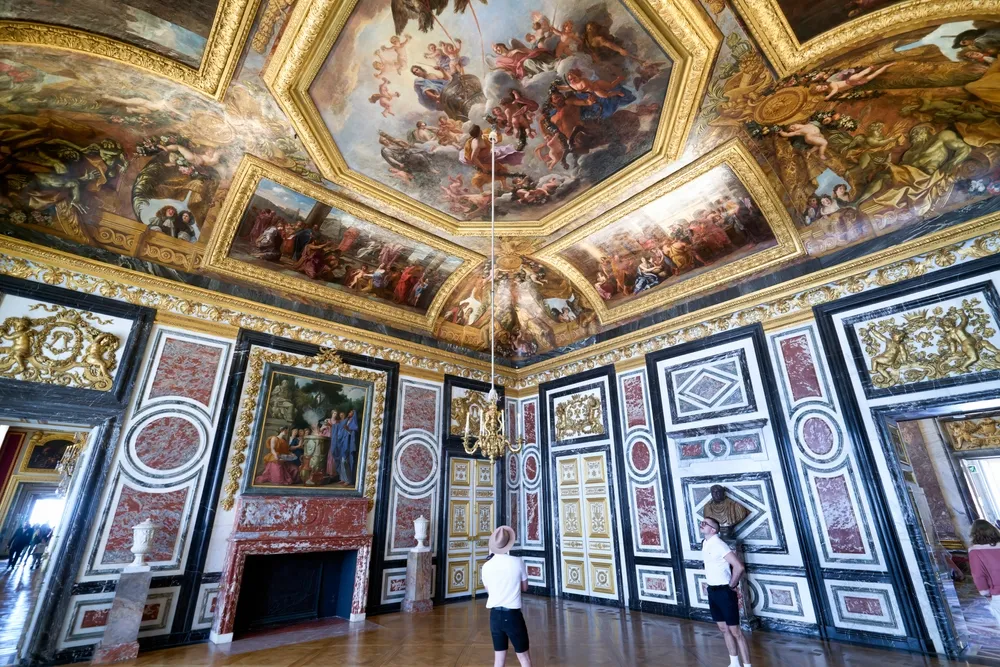
Most people who visit the Palace of Versailles spend their entire day in the main palace and the formal gardens directly in front of it. They walk the Hall of Mirrors, they photograph the parterre, they glance toward the Grand Canal, and then they leave. Which means most people who visit Versailles never find the part of the estate that tells the most human story of all.
A twenty-minute walk from the main palace, tucked into the northwestern corner of the estate, lies a completely different Versailles. Smaller, quieter, more intimate, and in many ways more revealing than anything inside the Grand Apartments. This is Marie Antoinette’s Versailles — the Petit Trianon, the Queen’s Theatre, the English Garden, and the Hameau de la Reine, the private hamlet she built to escape the suffocating formality of royal court life.
Understanding why she built it, what she was escaping from, and what she created in its place changes everything about how you read the woman behind the mythology. This guide covers the full story — the history, the spaces, the details most visitors miss, and how to plan your visit to this corner of Versailles properly.
Who Was Marie Antoinette — Beyond the Mythology
Before walking through her spaces, it helps to shed the mythology that surrounds Marie Antoinette and look at the historical reality. Because the woman who built the Petit Trianon and the Hameau de la Reine is significantly more interesting — and more sympathetic — than the caricature that history initially handed down.
A Teenager Dropped Into the Most Formal Court in Europe
Marie Antoinette arrived at Versailles in May 1770 at the age of fourteen. She had been raised in the relatively informal atmosphere of the Habsburg court in Vienna, where her mother Maria Theresa ran a busy, intellectually engaged household. Nothing in her upbringing prepared her for what she found at Versailles.
The court of Louis XV — and later Louis XVI — operated according to an elaborate system of ritual etiquette that governed every moment of a royal day. The lever, the morning ceremony during which the king rose from bed, involved dozens of courtiers each assigned a specific role in the dressing ritual. Meals were public performances. Even the most private moments of royal life were conducted in front of an audience of hundreds.
For a fourteen-year-old from Vienna, this was not merely unfamiliar. It was, by any reasonable measure, a form of controlled suffocation. Every account of Marie Antoinette’s early years at Versailles describes a young woman struggling to find any space — physical or psychological — that was genuinely her own.
The Queen’s Reputation — What Was True and What Wasn’t
The reputation that Marie Antoinette acquired during her lifetime — extravagant, frivolous, indifferent to the suffering of ordinary French people — was constructed largely by political enemies and a revolutionary press that needed a villain. Some elements were grounded in reality: her spending on fashion and the Petit Trianon renovation was genuinely excessive by any standard. Other elements — most famously the apocryphal “Let them eat cake” — were pure invention.
What the historical record actually shows is a woman who was politically naive in her early years, genuinely fond of her children, increasingly serious about her role as the Revolution approached, and ultimately brave in a way that her critics rarely acknowledge. The queen who was executed in October 1793 bore little resemblance to the teenager who had arrived at Versailles twenty-three years earlier.
Understanding this context doesn’t excuse the excess of the Trianon years. But it makes the spaces she created there legible in a way they aren’t if you approach them through the caricature.
Why She Needed to Escape — The Pressure of Public Royal Life
The specific pressure that drove Marie Antoinette to the Petit Trianon was the total absence of private life within the main palace. At Versailles, even eating breakfast was a public act. Walking from one room to another involved navigating corridors filled with courtiers jostling for position and attention.
The Petit Trianon gave her something that the Palace of Versailles structurally could not: a space where she controlled who entered. Only those she specifically invited — her ladies-in-waiting, her close friends, her children — were admitted to the Petit Trianon estate. No courtiers could appear uninvited. No political audiences were held there. It was, by design, a refuge — and understanding that function explains almost every choice she made in designing and furnishing it.
The Petit Trianon — A Palace Built for Privacy
The Petit Trianon itself predates Marie Antoinette by several decades. It was commissioned by Louis XV for his mistress Madame de Pompadour, though she died before it was completed. Louis XVI gave it to Marie Antoinette shortly after their marriage — an unusually generous and personal gift — and she proceeded to make it entirely her own.
The Architecture — Small, Perfect, and Deliberately Understated
The building is a masterpiece of neoclassical restraint. Architect Ange-Jacques Gabriel designed it in the 1760s as a deliberate counterpoint to the baroque excess of the main palace — four equal facades of clean stone, simple pilasters, no gilded excess. Seen from the English Garden it created, the Petit Trianon looks almost modest, which was entirely the point.
The interior is similarly refined. The rooms are small by Versailles standards — which is to say, they are approximately the size of a comfortable upper-middle-class house rather than a state room. The decoration that Marie Antoinette commissioned from the architect Richard Mique used pale colours, delicate floral motifs, and restrained neoclassical ornament. The boudoir, with its elaborate system of moveable mirrors that could be raised to cover the windows entirely at the touch of a mechanism, is one of the most technically ingenious rooms of the eighteenth century and one of the most charming.
Much of the original furniture was dispersed or destroyed during the Revolution, but significant restoration work through the nineteenth and twentieth centuries has returned the interior to something close to its appearance during Marie Antoinette’s occupation.
The English Garden — Nature as an Act of Rebellion
The formal French garden that surrounded the Petit Trianon before Marie Antoinette’s arrival was dismantled on her orders and replaced with an English landscape garden — a deliberate stylistic break from the geometric formality of Le Nôtre’s great garden outside the main palace.
The English Garden trend had arrived in France from Britain in the mid-eighteenth century, and it represented something philosophically distinct from the French formal tradition. Where Le Nôtre’s gardens imposed human order on nature, the English garden sought to enhance and romanticise natural forms — winding paths, irregular water features, carefully arranged natural-looking planting that was actually the product of meticulous design.
Marie Antoinette’s English Garden, designed by Richard Mique and the painter Hubert Robert, features a small lake, a grotto, a belvedere pavilion on an artificial mound, and winding paths that reveal different views at each turn. It is, in the context of Versailles, an act of gentle rebellion — a queen planting irregularity at the heart of the most formally ordered estate in Europe.
The Queen’s Theatre — Where She Performed for Her Inner Circle
One of the most unexpected spaces within the Petit Trianon estate is the small theatre that Marie Antoinette had constructed in 1780. Seating around 200 people — by invitation only — the theatre was where the queen indulged her genuine love of performance.
Marie Antoinette had grown up with music and theatre at the Habsburg court and brought that enthusiasm to Versailles. At the Queen’s Theatre, she did not merely attend performances — she participated in them, taking roles in operettas and plays performed for her carefully selected audience. This was scandalous by the standards of Versailles court etiquette, where the dignity of the royal person was considered incompatible with theatrical performance.
The theatre is beautifully preserved and retains much of its original painted and gilded decoration. It’s one of the spaces at Versailles where the sense of a real human life being lived — imperfect, playful, and stubbornly individual — is strongest.
The Hameau de la Reine — A Queen Who Built a Village
Nothing at Versailles is stranger, more debated, or more revealing than the Hameau de la Reine — the Queen’s Hamlet. Built between 1783 and 1787 to designs by Richard Mique, it is a collection of twelve rustic buildings arranged around an artificial lake, designed to resemble a working Norman farm village.
Why a Queen Built a Fake Farm — The Real Explanation
The Hameau has been interpreted as evidence of Marie Antoinette’s disconnect from reality — a queen playing at peasant life while actual peasants starved. This reading is understandable given the historical timing, but it misses the actual context significantly.
The concept of the ferme ornée — the ornamental farm — was a well-established aristocratic tradition across eighteenth-century Europe. Wealthy landowners across France, England, and the German states maintained idealised rural retreats as a form of pastoral fantasy rooted in Enlightenment philosophy. Rousseau’s ideas about the virtue of natural simplicity were enormously fashionable in precisely the circles Marie Antoinette moved in during the 1770s and 1780s.
The Hameau was not a commentary on poverty. It was an architectural expression of a philosophical fashion — and one that Marie Antoinette shared with virtually every other member of the European aristocracy of her generation. The political misfortune was in the timing: the Hameau was completed in 1787, two years before the Revolution began, which made its pastoral whimsy look catastrophically tone-deaf in retrospect.
Approaching the Hameau from the English Garden path, the effect is genuinely disorienting. The thatched roofs, the working mill, the dovecote, the dairy, and the farm buildings arranged around the lake with apparent casualness look less like a royal estate and more like a well-maintained English village that has somehow ended up inside a French royal park.
The buildings are real structures, not theatrical facades, and several of them have specific functions that were actually used. The dairy produced real dairy products. The farm maintained real livestock. Marie Antoinette genuinely brought her children here, and accounts of her time at the Hameau describe a relaxed, informal atmosphere that was the furthest thing from the ceremonial life of the main palace.
The interior of the Queen’s House — the main residential building — was furnished with a warmth and domesticity that is a complete counterpoint to the Grand Apartments in the main palace. Flowered fabrics, comfortable furniture, rooms scaled for living rather than receiving. It is the most human space at Versailles.
The Hameau Today — What’s Open and What to Expect
The Hameau de la Reine is fully open to visitors and forms part of the Marie Antoinette’s Estate ticket. The exterior of all twelve buildings can be explored freely, and the main residential interiors are accessible during standard visiting hours.
The walk from the main palace to the Hameau takes approximately twenty-five minutes on foot through the estate. The Petit Train land train stops near the Trianon area and reduces the walking distance significantly. For first-time visitors pressed for time, the Petit Train to the Trianon stop followed by a walking circuit through the English Garden and Hameau is the most efficient route.
Allow a minimum of ninety minutes for the Trianon estate and Hameau combined — two hours if you want to move at a pace that allows the spaces to actually register. This is not a section of Versailles to rush.
What Most Visitors Miss at the Trianon Estate
The Trianon estate is less crowded than the main palace at almost any time of year, which means the opportunities for genuine discovery are greater here than almost anywhere else on the Versailles estate. Here are four things that most visitors either miss entirely or walk past without stopping:
The Belvedere Pavilion in the English Garden is one of the most perfectly proportioned small buildings in France. An octagonal neoclassical pavilion set on an artificial mound overlooking the lake, it was used by Marie Antoinette for late-evening gatherings during the summer months. Most visitors follow the main path to the Hameau and miss the smaller path that leads up to it. The view from the belvedere across the English Garden lake is one of the quietest, most beautiful views at Versailles.
The Grand Trianon interior is consistently overshadowed by the Petit Trianon narrative — but the pink-marble colonnade palace that Louis XIV built for Madame de Maintenour is a remarkable building in its own right. Napoleon used it as a secondary residence and left significant furnishings from the Empire period. The combination of Louis XIV architecture and Napoleonic furniture creates an atmosphere found nowhere else at Versailles, and the visitor numbers are a fraction of the main palace.
The Temple of Love — a small circular colonnaded temple set on an island in the English Garden — is one of those structures that appears in a hundred Versailles photographs but that visitors consistently fail to locate in person. It sits at the edge of the lake, accessible by a small bridge, and houses a copy of Bouchardon’s Cupid sculpture. In late afternoon light it looks, without exaggeration, like a stage set from a dream.
The Queen’s dairy interior at the Hameau is open on specific days and is worth timing your visit to catch. The interior retains its original Sèvres porcelain decoration — a dairy lined with fine porcelain was, even by the standards of Versailles, an extraordinary statement of priorities — and provides the clearest illustration of the contradiction at the heart of the Hameau: a building designed to evoke rustic simplicity, decorated with some of the most expensive objects in France.
How to Visit the Trianon Estate — Planning Your Day Properly
Tickets — What You Need and How to Buy Them
The Trianon domain — which includes the Grand Trianon, the Petit Trianon, and Marie Antoinette’s Estate — requires a separate ticket from the main palace entry. The Petit Trianon and Marie Antoinette’s Estate are covered under the same ticket. The Grand Trianon is included in most full-access combinations.
The clearest approach is to book a full-access Versailles Palace and Trianon ticket online before your visit. This covers the main palace, the gardens on Musical Fountain Show days, and the complete Trianon domain — removing the need to make ticket decisions at the gate under pressure.
The Trianon estate has its own entrance gate on the northern edge of the gardens, which can be accessed directly without passing through the main palace entrance. If your primary focus is the Trianon and Hameau rather than the main palace, this route saves significant time and avoids the heaviest crowd concentrations at the main entrance.
Getting from the Main Palace to the Trianon — Your Options
The walk from the main palace terrace to the Petit Trianon through the gardens takes approximately twenty minutes along well-marked, well-maintained paths. This is the recommended approach for visitors with comfortable walking shoes and adequate time — the walk itself passes through sections of the gardens that reveal the estate’s scale in a way that the train or golf cart cannot.
The Petit Train land train connects the main palace, the Grand Canal embarkation point, and the Trianon area with stops throughout the day. Tickets for the train are purchased separately and are worth it in peak summer heat or for visitors covering the full estate in a single day.
Electric golf carts hired near the palace terrace can also reach the Trianon area via the estate’s carriage roads. For families with young children or visitors with mobility considerations, the cart option allows full coverage of the estate without the walking distances becoming prohibitive.
How Long to Spend and What to Prioritise
A thorough visit to the Trianon estate — Grand Trianon interior, Petit Trianon interior, English Garden, Temple of Love, Hameau de la Reine — comfortably takes three hours. For visitors combining this with a morning in the main palace and the Musical Fountain Show, this is a full day.
If time is limited, prioritise in this order: the Petit Trianon interior first, then the Hameau de la Reine, then the English Garden circuit. The Grand Trianon, while worthwhile, is the most dispensable element for a first visit if choices must be made.
The Trianon estate is significantly quieter than the main palace at almost every time of year. Even on busy summer weekends when the main palace is genuinely crowded, the Hameau on a weekday afternoon can feel almost private. This is one of the best arguments for spending more rather than less time in this corner of the estate.
Conclusion
Marie Antoinette’s corner of Versailles tells a story that the main palace, for all its grandeur, cannot quite reach. It’s the story of a person navigating an impossible situation — dropped into the most formal, most public, most scrutinised court in Europe as a teenager — and finding, within that situation, whatever small spaces of genuine life she could create.
The Petit Trianon is where she had a door she could close. The English Garden is where she could walk without ceremony. The Queen’s Theatre is where she could perform and laugh and be something other than a symbol. The Hameau is where she brought her children and, for a few years before history arrived at the gate, lived something that resembled an ordinary life.
None of it excuses the excesses or the political misjudgements. But walking through these spaces with the real story in mind — rather than the mythology — produces something more valuable than a tick on a sightseeing list. It produces an encounter with an actual human being who lived in an extraordinary place and tried, imperfectly and sometimes misguidedly, to make it habitable.
Book your Versailles tickets with the Trianon domain included, allow a full day for the estate, and walk the path to the Hameau in the late afternoon when the crowds have thinned and the light is low. The Queen’s private world rewards every visitor who takes the time to actually find it.