
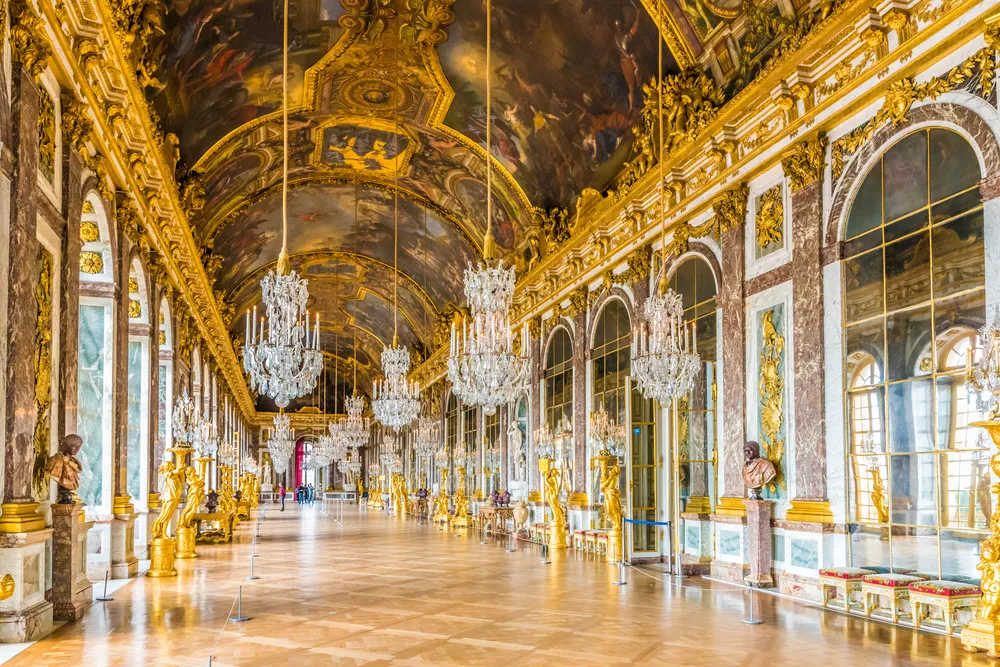
Most people walk through the Hall of Mirrors at the Palace of Versailles the same way. They look up, they take a photo, they move on. And honestly? That’s understandable. With 357 mirrors lining the walls, seventeen gilded arched windows flooding the gallery with light, and ceiling paintings stretching eighty metres above you, the sensory hit is immediate and overwhelming.
But here’s the thing — the Hall of Mirrors is one of the most deliberately constructed rooms in European history. Every detail, from the placement of the mirrors to the scenes painted overhead, was designed to communicate something specific about power, ambition, and the man who built it all. Walking through without knowing the context is a bit like watching a film in a language you don’t speak. You can see it’s impressive. You just don’t know what it’s actually saying.
This guide covers the full story: why Louis XIV built it, what you’re actually looking at when you walk through, the historic moments this room has witnessed, what most visitors walk straight past, and how to plan your Versailles visit to experience the Hall of Mirrors the way it deserves.
The Story Behind the Glass — Why Louis XIV Built It
The Hall of Mirrors was not always part of the plan. When Louis XIV first inherited Versailles as a modest hunting lodge from his father Louis XIII, the site that would become this gallery was an open terrace overlooking the gardens. What changed everything was a king who decided that France — and more specifically, he — needed a room the world would never forget.
A King Who Wanted the World to Watch
Louis XIV was twenty-two years old when he took personal control of France in 1661, following the death of Cardinal Mazarin. From that point on, he engineered every aspect of his public image with extraordinary precision. Versailles was not just a palace — it was a performance space, and the Hall of Mirrors was its main stage.
Foreign ambassadors were received here. Formal audiences were held here. The court of Versailles — which at its peak housed some ten thousand people on the estate — processed through this gallery daily. Louis understood that space communicates status, and he designed the Hall of Mirrors to communicate it louder than anywhere else in Europe.
Replacing the Terrace: The Architectural Gamble That Paid Off
The decision to enclose the terrace and create the gallery was made in 1678, and the man tasked with executing it was Jules Hardouin-Mansart, the principal architect of the Versailles expansion. The challenge was significant: create a room that matched the grandeur of the gardens outside while simultaneously focusing all attention back on the king.
The solution — seventeen arched windows on the garden side, mirrored with seventeen arched mirror panels on the opposite wall — was an architectural masterstroke. The mirrors doubled the apparent size of the room and reflected the gardens back into it. The effect was deliberate: wherever you stood, you were surrounded by Versailles. There was no looking away.
Every Detail Was a Political Statement
In the seventeenth century, Venetian mirrors were among the most expensive luxury objects in Europe. Venice held a near-monopoly on mirror-making technology, and Venetian craftsmen were famously secretive about their methods. Louis XIV, in a characteristically audacious move, hired away a group of Venetian glassmakers to establish a French mirror industry — and then used the resulting mirrors to line the most public room in his palace.
Every one of the 20,000 mirrors used in the gallery was a statement: France had surpassed Venice. The room was luxury as propaganda, and it worked on every visitor who walked through it — exactly as intended.
What You’re Actually Looking At When You Walk Through
The ceiling is where most of the meaning lives — and it’s also where most visitors spend the least time looking. Charles Le Brun, the king’s chief painter, designed and oversaw the entire programme of ceiling paintings across the gallery. The thirty paintings directly overhead chart the military campaigns and diplomatic victories of Louis XIV’s reign between 1661 and 1678.
Louis is depicted not as a human king but as a classical hero — in the style of Roman emperors, draped in armour, accompanied by allegorical figures representing Victory, Fame, and the subjugated nations of Europe. This was not accidental humility. It was a carefully constructed mythology being written in paint, on the ceiling of a room that every significant visitor to France would pass through.
The pilasters between the windows and mirror panels are bronze — or rather, gilded with bronze-painted plaster, which was itself a deliberate cost-cutting substitution that still managed to look extraordinary. The original furnishings of the gallery, which Louis famously had made entirely from solid silver, were melted down in 1689 to fund his wars. What you see today is a reconstruction of the original design, with silver replaced by gilded wood. The room is still astonishing. The silver version must have been almost incomprehensible.
The History That Happened Inside This Room
Very few rooms in the world can claim to have hosted events that genuinely changed history. The Hall of Mirrors at the Palace of Versailles is one of them — and the events it witnessed stretch across two centuries of European upheaval.
On January 18th, 1871, the German Empire was proclaimed in this gallery. Following France’s defeat in the Franco-Prussian War, Otto von Bismarck orchestrated the unification of the German states inside the most symbolically French room in existence. It was a deliberate humiliation — and one that France would not forget. The choice of location sent a message that the words of the proclamation alone could not.
Then, on June 28th, 1919, the tables turned. The Treaty of Versailles — formally ending the First World War — was signed in this same gallery. France had chosen the location with full awareness of what had happened there forty-eight years earlier. The Hall of Mirrors was the answer to 1871, written in international law.
Before any of that, the gallery had been the backdrop for the daily theatre of royal life at Versailles. The King’s procession to chapel passed through here every morning. Marie Antoinette walked this floor. Napoleon walked this floor. The French Revolution transformed the Palace of Versailles from a working royal court into a national monument, and the Hall of Mirrors survived the transition intact — which, given what the Revolution did to many other symbols of royal excess, was far from guaranteed.
What Most Visitors Miss (But Shouldn’t)
The Hall of Mirrors rewards the visitors who slow down. Here are four things that most people walk straight past — each one worth stopping for:
- The ceiling panels above the central section depict Louis XIV’s most significant military campaigns. The detail in Le Brun’s compositions is extraordinary up close — battle scenes, naval victories, diplomatic triumphs. Most visitors glance up once and move on. A guide who can identify and explain each scene transforms the ceiling from beautiful decoration into a narrative you can actually follow.
- The arched mirror panels are positioned to reflect the gardens outside at a specific angle. Stand at the central point of the gallery and look toward the windows — then turn and look at the mirrors. The reflection creates a sense of the room extending infinitely in both directions. This was intentional. Hardouin-Mansart designed the alignment so the mirror panels don’t just reflect the windows opposite; they reflect each other, creating an effect of infinite recession. It works best in morning light.
- The original silver furniture is gone — melted in 1689 — but the floor survives. The parquet beneath your feet is original seventeenth-century craftsmanship, and the patterns were specifically designed to complement the rhythm of windows and mirrors above. Most visitors are too busy looking up to notice what they’re standing on.
- The spot where the Treaty of Versailles was signed in 1919 is marked — but quietly. At the far end of the gallery, there is a specific location where the signing table was positioned during the Paris Peace Conference. It’s one of the few places in the room where the weight of what happened here lands fully, if you know to look for it.
How to Experience the Hall of Mirrors the Right Way
Knowing the history is one thing. Actually experiencing the Hall of Mirrors the way it deserves requires a bit of planning — because the difference between a good visit and a genuinely memorable one usually comes down to timing, access, and how you arrive.
Best Time to Visit for Light, Crowds & Photography
The Hall of Mirrors faces west, which means morning light from the garden-facing windows floods the gallery in a way that afternoon visits simply don’t replicate. If you’re visiting the Palace of Versailles for photography, or if you want to see the room at its most visually dramatic, arriving at palace opening time — 9:00 AM from April through October — puts you in the gallery during peak natural light and before the bulk of daily visitor numbers arrive.
By midday in peak season — July and August in particular — the gallery fills with visitor traffic that makes it genuinely difficult to stop, look up, and absorb the room at your own pace. Weekdays are significantly quieter than weekends throughout the year. If you have any flexibility in your Versailles visit timing, a Tuesday or Wednesday morning arrival transforms the experience.
Guided Tour vs. Self-Guided — Which One Actually Does It Justice
This is one of those rare cases where the answer is unambiguously in favour of a guided tour — at least for the Hall of Mirrors specifically.
The gallery is rich with context that a self-guided visit, even one enhanced by an audio guide, struggles to convey fully. A good guide can point to specific ceiling panels and tell you which military campaign they represent, explain the significance of the mirror placement in its political context, describe what the original silver furnishings looked like, and tell you exactly where the 1919 treaty signing happened and why the location was chosen.
The official audio guide available with Versailles tickets is a useful baseline, particularly for first-time visitors. But a small-group guided tour that includes the Hall of Mirrors as a dedicated section — rather than a brief stop — is a meaningfully different experience. Versailles skip-the-line guided tours that prioritise the palace interior over the gardens are the right option if the Hall of Mirrors is your primary focus.
Tickets, Access & What’s Included in Your Entry
The Hall of Mirrors is included in the standard Versailles Palace ticket — you do not need a separate admission for the gallery itself. What the standard ticket includes is access to the Grand Apartments, the Hall of Mirrors, and the Queen’s Apartments. The Gardens, the Grand Trianon, and the Petit Trianon and Marie Antoinette’s Estate may require separate or upgraded tickets depending on the day and season.
Versailles tickets should be booked online in advance. From April through October, the palace operates under significant visitor pressure, and same-day tickets are unreliable. Versailles skip-the-line tickets are worth the premium during peak season — the standard entrance queue on busy days can add thirty to sixty minutes to your arrival time, which directly affects your window for the morning light in the gallery.
If you’re travelling from Paris, the RER C to Versailles Château Rive Gauche is the standard route — approximately forty-five minutes from central Paris, with the palace entrance a short walk from the station. Guided tours by deluxe minibus from Paris are also available if you prefer a door-to-door experience with logistics fully handled.
Conclusion
The Hall of Mirrors at the Palace of Versailles is not just the most photographed room in France — it’s one of the most deliberately constructed spaces in European history. Every mirror, every ceiling panel, every gilded surface was put there to say something specific about power, ambition, and the man who built it all.
The room has also witnessed history that no architect could have planned: a German proclamation, a global peace treaty, centuries of court life, revolution, and restoration. That layering is what makes it genuinely extraordinary — not just as a piece of decorative art, but as a place where the weight of what happened here is still palpable if you take a moment to let it land.
Book your Versailles Palace tickets in advance, arrive early for the light and the quiet, and give yourself more than a passing glance at the ceiling. The Hall of Mirrors will reward every minute of attention you bring to it.